«The blockade silently kills and punishes our population like never before»
- Written by Cubaminrex
- Published in Cuba
- Hits: 63
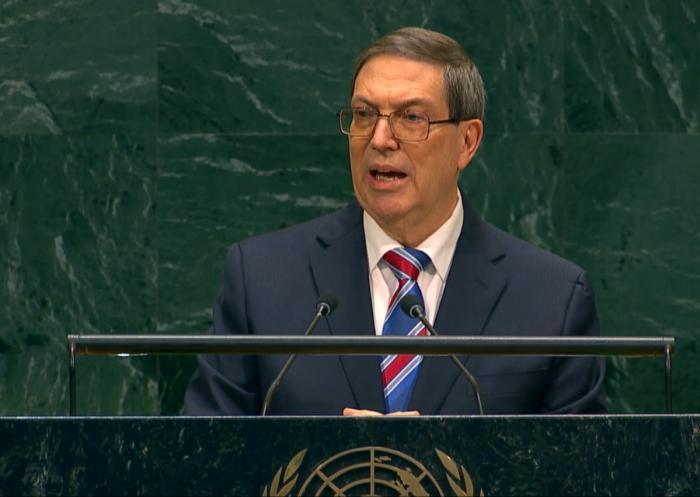 Intervention by the Minister of Foreign Affairs of Cuba, Bruno Rodríguez Parrilla, during the debate on topic 37 of the UNGA agenda "Need to end the economic, commercial and financial blockade imposed by the United States against Cuba".
Mr. President, your excellencies, permanent representatives, distinguished delegates:
I wish to express condolences to the Kingdom of Spain for the loss of life in the Toledo railway accident. I would like to commend the way in which the President of the General Assembly made the Rules of Procedure of this Assembly prevail yesterday.
I must denounce the disrespectful and provocative attitude of the United States delegation yesterday in this room, in particular the harassment and filming without consent by one of its officials against our delegation, which involved the intervention of United Nations security personnel. These are acts incompatible with decorum, respect for personal dignity and privacy that must prevail in this venue, and it is also a maneuver against an important Cuban candidacy for a United Nations body.
I denounce the presence in this room of a known terrorist, responsible for acts of terrorism against Cuba, representative of two terrorist organizations based in the territory of the United States, invited by the permanent mission of the United States to the United Nations. He is number 52 on the list of people wanted internationally by the Republic of Cuba, according to legal resolution and Official Gazette, for acts of terrorism.
He is also a criminal responsible for fraud that has received copious funding from the United States government and diverted for personal use. I ask you, Mr. President, to ask the United Nations Secretariat to check the condition in which this subject is present in the gallery and I request that he be removed immediately. It is an offense, Mr. President, to all victims of terrorism, in particular to the victims of September 11th and the Cuban victims of terrorist acts organized and financed from United States territory. It is an outrage and a total demonstration that it is not Cuba that should appear on the infamous List of countries sponsoring terrorism.
Dear ambassadors, dear delegates:
Yesterday's speech by the representative of the United States of America makes the task of our Assembly and my responsibility to argue the positions of the Republic of Cuba easier.
He made the phrase “This is America” famous. It is not a lapse, it is not a mere illegal conceptual error. This is the United Nations, it is the United Nations Organization, it is the capital of multilateralism, it is the capital of an international order that should be based on International Law and the Charter of the United Nations, it is the most universal and democratic body of the United Nations.
That phrase reflects a worldview that treats and considers the planet as if it were part of U.S. territory—viewing Cuba and its people as if they were akin to one of the 50 states of the Union. It is the foundation of the concept of "peace through strength"—the imposition of peace through force.
Cuba is not a threat; the blockade is. It is the height of cynicism and hypocrisy to label Cuba an "unusual and extraordinary threat" to the national security of the world’s greatest nuclear power.
Yesterday, the United States representative uttered another significant statement that clarifies matters further: "The blockade against Cuba does not exist."
Every minute of procedural delay—every minute spent in our deliberations—inflicts extraordinary harm upon our people. This cannot be measured by the clock in this chamber; rather—and I ask the webcast to zoom in—it can be measured by this counter, which tracks the damage caused by the blockade against Cuba since this session began yesterday, calculated in current U.S. dollars. Since the start of this session, the damage inflicted by the blockade has amounted to more than 22.9 million dollars.
Mr. President:
A major power is waging economic war against a member state of this Organization—a small, independent, and peaceful nation committed to solidarity. It does so with the aim of domination and "regime change." This aggression includes a fuel blockade—tantamount to a naval blockade—which constitutes an act of war, an act of collective punishment, and an act of genocide, all of which are prohibited under international law. Its severe consequences fall upon the people, restricting their fundamental rights, affecting third-party nations, and transforming the essential needs of the population into instruments of political coercion. Its effects are felt at the tables of Cuban families, at the bedside of the sick, during childbirth or in the operating room, in the food provided to children or in their classrooms; they manifest as a lack of electricity, potable water, and medicine, and as the high cost of essential goods required for life.
The General Assembly has addressed this issue since 1992, but today it does so within a new and extraordinary context. The United States government has unleashed a wave of pressure, intimidation, and blackmail against many member states, issuing a coercive, illegal, immoral, and unjustified demand that they abandon their long-standing, well-founded, and consistent positions—positions they have maintained for decades as an exercise of their sovereignty. I can demonstrate this with a document I have here; it is likely already in the possession of many of you.
The question is how the General Assembly will define its stance regarding the use of intimidation and unilateral coercive measures—tactics employed to dictate to other member states what they should say and how they should vote; which nations they may trade with freely and which they may not; where their shipping companies may operate and where they may not; and with which countries they may maintain financial relations and with which they may not.
Today, this pressure is directed at Cuba; against which other state might it be used tomorrow?
Furthermore, we must decide today whether the United Nations will condemn or accept collective punishment—the attempt to break the political will of a sovereign state through economic strangulation, the infliction of hunger, suffering, and despair upon an entire population, or the outright destruction of a nation.
It is well known that, since the beginning of this year, the United States government has drastically intensified its aggression against Cuba, with the explicitly and officially stated objective of seizing the country, controlling its economy, and establishing its own domination. It has openly used the threat of military force and imposed dozens of additional coercive economic measures—on top of those that have existed for decades—which have been intensified to an extreme degree since 2019 and, as of last January, transformed into a medieval-style siege.
Since July, the aggression has acquired a new and stark dimension, with the efforts of the U.S .government to hinder, hinder and sabotage the broad program of economic and social transformations that our country has sovereignly outlined in its economic and business order to adapt to the disastrous changes in the international economic order and in the face of the imposed economic war. Despite everything, we will not give up in this effort for the well-being and dignity of Cubans.
The Secretary of State, referring to Cuba's efforts, publicly expressed on August 7, and I quote: "what we are trying to make them understand is that there is no escape valve... every time they create a new mechanism to try to free themselves from the noose of the gallows, we will simply tighten it more." End of quote.
The pretext most used and manipulated by the United States government to try to justify its actions is to present Cuba as a supposed threat to the nuclear superpower or even to the hemisphere. It is known that no government represented here admits or accepts such a gross fallacy. They lack arguments.
In addition to other considerations that are known and evident, the United States government knows and could recognize if it acted honestly that, far from constituting a threat, Cuba has contributed to the national security priorities of that country. The Cuban government has provided on several occasions, over the years, sensitive information related to threats linked to drug trafficking, terrorism and other transnational crimes of potential impact for the United States and the region. This is information provided even in recent times, despite the manifest hostility of this government.
The fuel blockade is an act of collective punishment that threatens the lives of Cubans.
The mendacious accusations about Cuba are known and none withstand the slightest scrutiny. They add as a pretext fantastic accusations about inequalities, alleged hoarding of wealth and favored elites. It is made by the largest and most corrupt plutocracy in history, where money rules instead of voters, which has the largest and most politically influential military-industrial complex, considered a danger for this dysfunctional democracy in itself.
They also use as a pretext that Cuba supposedly practices slavery or human trafficking, slandering medical personnel and international health cooperation programs in more than 50 of the States represented here, and deploying cruel pressure and blackmail to abort them.
The blockade silently kills and punishes our population like never before. Since the beginning of the maximum pressure policy our infant mortality rate has doubled. They are not statistics, they are not figures, they are children, they are lives cut short at birth with immense pain for those families.
Many of you are mothers or fathers; you know that no statistic can capture what it means to be without medicine for one’s child, or what it is like for a family to wait for a surgery that keeps getting postponed.
Today, 70% of the essential medicines are unavailable—even though we are capable of producing all, or nearly all, of them—and some 100,000 people, including 12,000 children, are waiting for surgeries. We are here today for the sake of those children and their families in Cuba, and for our self-sacrificing, closely-knit, educated, and conscious people—a noble, compassionate, patriotic, and dignified nation that never stops, that rises every single day to overcome obstacles, seeking out and contributing to solutions through extraordinary effort.
No people deserves the suffering and abuse currently being imposed upon us.
This is the drug Pemetrexed, produced by the company Eli Lilly here in the United States. It is ideal for treating lung cancer. In my country, there are patients who need it but cannot obtain it—not because it doesn’t exist, and not because we couldn’t afford to pay for it; we don’t have it because it is an American product, and the blockade prevents us from purchasing it.
The number of deaths from cancer in Cuba has risen significantly. Although Cuban survival rates remain higher than those in most low- and middle-income countries—comparable to those in the developed world and exceeding the targets set by the World Health Organization—they have declined in recent years. For children and young people, the survival rate has fallen from 85% to 65%—a trend that coincides with the most difficult periods of the energy blockade.
This is the drug Neuralcim—a Cuban-made medication. Why does the blockade against Cuba prevent 7 million Americans from benefiting from this unique drug, which can address Alzheimer’s, senile dementia, and other neurodegenerative diseases—a treatment with proven effectiveness that is incomparably superior to similar alternatives? The absurd policy of the U.S. government blocks everything that sustains life. This cancer drug—along with another medication containing a molecule that helps thousands of people delay the painful process of forgetting—is being blocked by an infamous policy.
We are not talking about numbers; we are talking about lives, opportunities for recovery, tragedies and trauma, and the daily anguish experienced by medical and healthcare personnel.
The country’s electricity generation—derived from mobile power units and fuel- or diesel-powered generators—has been drastically reduced.
In Cuba, 85% of the systems used to pump drinking water rely on electricity; as a result, 2.6 million people face difficulties in accessing potable water.
The United States government has obstructed the delivery of 7,000 shipping containers—contracted even by private Cuban companies—containing, for the most part, food, medicines, medical equipment, and supplies for hemodialysis, all of which failed to arrive at our ports in a timely manner.
The targeting of shipping companies, the interception of vessels, and the imposition of secondary sanctions against any entity that engages with Cuba violate international trade norms and the freedom of navigation.
Six out of every ten Americans wish to normalize relations with Cuba, oppose military action, oppose “taking control” of the island, and state that they do not trust their government’s decisions on this matter. Half of all Americans oppose the fuel blockade—a measure supported by only a quarter of the population. In public discourse over the last few weeks, 72% of U.S. citizens—the taxpayers who fund this mission, the voters who elect their government—have expressed opposition to the blockade against Cuba.
The United States government has no right or prerogative to attempt to govern the Cuban population, interfere in the country’s internal affairs, determine the nation’s destiny, seize its wealth, or exercise dominion over our territory.
The few, draconian, and burdensome exceptions to the blockade—granted through highly restricted government licenses—do not prove that the blockade does not exist; in fact, they prove the exact opposite.
The misleading figure of $100 million in humanitarian aid—of which only a few hundred thousand dollars have actually reached Cuba—is equivalent (even if the full $100 million were delivered) to the economic damage caused by the blockade in just five days; it would only be enough to fund limited electricity generation for a mere two weeks. We welcome this humanitarian aid and hope that no attempts will be made to manipulate it for political purposes. However, humanitarian aid cannot replace Cuba’s right to trade free from U.S. sanctions and political manipulation.
We are convinced that a respectful, cooperative relationship with the United States would be beneficial for the people of Cuba and the people of the United States alike—serving their interests, their well-being, and their natural desire for peace. It would also be beneficial for the peoples of "Our America" and the entire hemisphere.
The measures taken against my country have been explicitly designed to inflict the greatest possible harm, in the shortest possible time, upon an entire nation. These are not like the so-called—and equally unacceptable—“collateral damage.” The harm inflicted upon individuals, families, and the people of Cuba is deliberate—a matter of design and political decision.
The aim is to trigger a humanitarian crisis in Cuba to be used as a weapon. We have prevented this, and we will continue to prevent it, thanks to the solidarity within our communities; the understanding and democratic participation of the people—along with grassroots organizations and civil society—in the adoption and implementation of economic and social measures; the effectiveness of the bodies of People’s Power and the efficiency of government administration; our comparative advantages; rapid and significant investment in photovoltaic energy; an increase in the production of domestic crude oil; the development of Cuban technology to refine that oil, given its specific characteristics; and the safeguarding of energy supplies for our hospitals, water sources, and social centers.
This has also been achieved through the efficient reorganization of health and educational services; robust and effective social policies that protect low-income and highly vulnerable individuals; the development of electric transport; the growth and social commitment of the private sector; an increase in cultivated land; and the practice of agroecology.
In a few moments, this General Assembly must decide whether it is acceptable—or, rather, reprehensible—for this crime against Cuba and its people to continue. It must determine whether a superpower should be permitted to persist in its attempt to impose its own will upon the political decisions and sovereign rights of the rest of the international community—upon each of the States that you represent.
For Cuba, there is no dilemma. Under the leadership of the leader of the Cuban Revolution, Army General Raúl Castro Ruz, and President Miguel Díaz-Canel Bermúdez, we will persist in defending our independence and national sovereignty, and in rejecting the ambitions of conquest and domination held by an imperialist power. We do so because these are inalienable rights and non-negotiable obligations of Cuba—of the Cuban nation. We are supported by international law and the Charter of the United Nations.
What Cuba asks for is simply to be left alone—to allow the Cuban people to live in peace, to resolve our own problems peacefully, and to find solutions to the great challenges of today’s world, free from political, military, cognitive, or economic aggression.
Cuba is not a threat! The blockade is!
The energy blockade is an act of collective punishment.
Therefore, as we proceed to consider draft resolution A/81/L.5—which I have the honor to present on behalf of the heroic, compassionate, and noble Cuban people—each country will demonstrate its own sense of justice and courage, both before the world and before its own people.
On the centenary of Commander-in-Chief Fidel Castro Ruz, we repeat his words today: Homeland or Death! We shall overcome!
Source : Granma
