Fidel: always great
- Written by Rodobaldo Martínez Pérez
- Published in Opinion
- Hits: 604
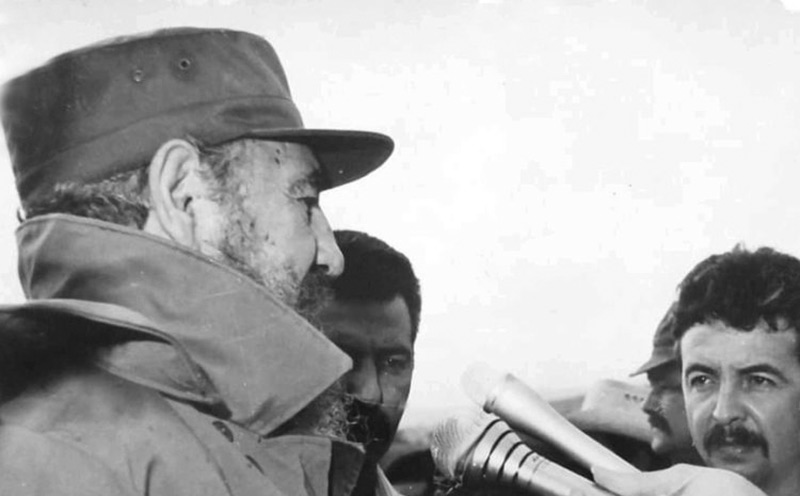
“Fidel is phenomenal,” so chant several Asturians in Porto, on a cold October dawn as several European groups await the Commander, at the sports center in the town of Matosinhos, during the VIII Ibero-American Summit in 1998, at the act of Confraternization with the Solidarity with Cuba organizations of the Iberian Peninsula of Spain and Portugal.
On that cold dawn, the Commander arrives because he knew friends who came to ratify their support were waiting for him. In a torrent of applause and shouts of ¡Viva Cuba! Until almost dawn, without the support of any document, he speaks of each and every one of the most complex and serious issues of the international political situation and singles out that of Latin America and especially that of Cuba.
And he said, “Be assured, friends, that we will win!”.
It is the only time abroad that I participate in an activity with Fidel; the others, up to over 20, are in Cuba.
The editors of ¡ahora! ask me for a few lines about my experiences covering news with the Leader of the Revolution. All are published in ¡ahora! and in other media.
That privilege began on July 27, 1977, with the inauguration of the sugarcane combine factory, until July 26, 2006, the 46th official visit to the province and, unfortunately, his last public appearance at the opening of the largest power generation unit, built in the country and synchronized to the national power system, both in the city of Holguín.
Fidel always demonstrated his infinite confidence in his people, in winning the future, and overflows with that conspiratorial and mystical empathy rarely seen in a statesman of this world.
We must learn from his optimism and his infinite faith in victory, without ever accepting defeat. That is why when in Boniato prison, due to the events of July 26, 1953, when the henchmen of the Batista tyranny took him to the courtyard to try to humiliate him upon seeing his surviving comrades arrive in grim conditions, as Raúl later told me, his face reflected his gallantry, like a review of future successes.
He continued to give timeless lessons on prestige, honesty, personal example, and altruism, but his most encompassing legacy is, without a doubt, achieving the Work of January First and ensuring its continuity.
He never dealt with disorder or sloppiness in any action, and never renounced the principles. He proclaimed equity, optimism, and resistance as non-negotiable actions for a Cuban revolutionary in any situation.
He gave lessons for posterity in every dialogue, especially with pioneers and youth, which is why his thought must be internalized to have a complete development plan in any discipline or action of the Revolution and to be able to consciously say, “I am Fidel!”.
Always, regardless of the circumstances, the time of day, or the complexity of the issue, he was bold, inquisitive, eager for knowledge, anti-dogmatic, with an incredible capacity for foresight. “Fidel travels to the future, returns, and explains it,” says former Algerian president Abdelaziz Bouteflika.
We can permanently turn to Fidel to find answers for this chaotic world and know how to act intelligently in complex and difficult decision-making, because talent cannot be lacking in any strategy that signifies survival, regardless of such complex realities for today´s Cuba, attacked with the greatest ferocity, wrapped in the worst fallacies as never before by the all-powerful and greedy empire.
The best response must be actively in the Cuban streets: resistance, intelligence, and courage, to preserve the design of building socialism today, at any price and risk.
His entire life, dedicated to the Fatherland, identifies his name with Cuba, the flag, the coat of arms, or the national anthem, and it is that Fidel, in our national history, full of extraordinary men, occupies a central place for his successes in leading the revolutionary government, right under the nose of hatred.
The fulfillment of everything we set out to do must be the first premise for safeguarding such high honor. To act, to convince, and to win over the people every day are obligations, in order not to fall into useless slogans or utopias, but into actions that make every phrase evident.
He tought us that the only weapon to move forward depends on ourselves, he vehemently defended eliminating disorder and shoddy work in any action, without admitting failure or renouncing duties. He protected equity, with optimism and resistance as inalienable principles.
To journalists, he told us, "Consider me one of you" and "I am dreaming of journalists with all the resources to do their job, of optimal journalists. It is a dream we can achieve."
"I see the press playing a very important role in raising morale and in preserving all the sacred values of our people, in bravely denouncing what is done wrong, in the combat, in the fight against all wrong things (...) Who can educate more than the press?"
"You must continue studying your whole life. Today it is not possible to stop studying, today it is not possible to stop improving!"
Not infrequently, the eternal leader of the Cuban Revolution, Fidel Castro Ruz, dedicates so much time to the work of the press, to necessary reflections, to direct and sincere messages from a critical and self-critical point of view, as he always expresses himself.
To the Cuban press, the internet calls it, and said so as early as 1999, as: "the heavy artillery of the Cuban Revolution."
"Journalists must investigate, know what is going wrong, what actions harm the country's economy, what corrupts people, and not only expose them but combat them through that powerful instrument that is the mass media. I prefer to be wrong rather than decide not to criticize."
"Every journalist must be a gladiator against things that, in their judgment, are going incorrectly. And they are also a fighter for things to go well, a creator of the new society."
"All professionals should know history, but journalists a little more. One cannot be a journalist without knowing the History of Cuba and the world."
"The country must be turned into a great school for improvement in Journalism. We must not be afraid of having a few more journalists."
"I think it would be advisable to have more capacity in language and computer studies... And not to neglect the Spanish language, we all need a little more Spanish grammar."
His enlightened affirmation that the present "corresponded to a tenacious battle of ideas, in which intelligence and culture were invaluable weapons," are inalienable principles for today's Cuban journalists, always in favor of their Revolution.
And he reflects: They constitute true lessons in pedagogy, wisdom, and practice for professional exercise, from someone who always calls himself an active member of our ranks.
It is the challenge that we journalists have with Fidel today and always. I recall: "I see the press playing a very important role in raising morale and in preserving all the sacred values of our people, in denunciation, in combat, in the fight against all wrong things (...) Who can educate more than the press?"
"You have to keep studying your whole life. Today it is not possible to stop studying, today it is not possible to stop improving!". Not infrequently, the eternal leader of the Cuban Revolution, Fidel Castro Ruz, dedicates so much time to working with the press, necessary reflections, direct and sincere messages from the critical and self-critical point of view as he always expresses himself. Cuban press on the internet calls it, as early as 1999, as: "the heavy artillery of the Cuban Revolution."
His enlightened assertion that the present “corresponded to a tenacious battle of ideas, in which intelligence and culture were invaluable weapons,” are inalienable principles for Cuban journalists, always in favor of their Revolution.
On June 2, 2002, after the rally on the first day in Calixto García Revolution Square, he decided to go, at dawn, to the five-star Río de Oro hotel in the Holguín tourist hub.
There, I took the opportunity and said to him: “Commander, I want to tell you something.” He looked at me intently – I was the only journalist present – and replied, “Go ahead: ‘I want to thank you, on behalf of my colleagues, for the material gifts received…’”
There is a silence, he puts his hand on my shoulder and tells me: "I am the one who is grateful to you."
I prefer to end with his last visit to his province when the crowd chants louder and louder “Fidel, we love you” and he responds with deep affection: “I love you all very much too.”
