Trump, Cuba, and the "Cherry on Top"
- Written by M. H. Lagarde
- Published in Cuba
- Hits: 912
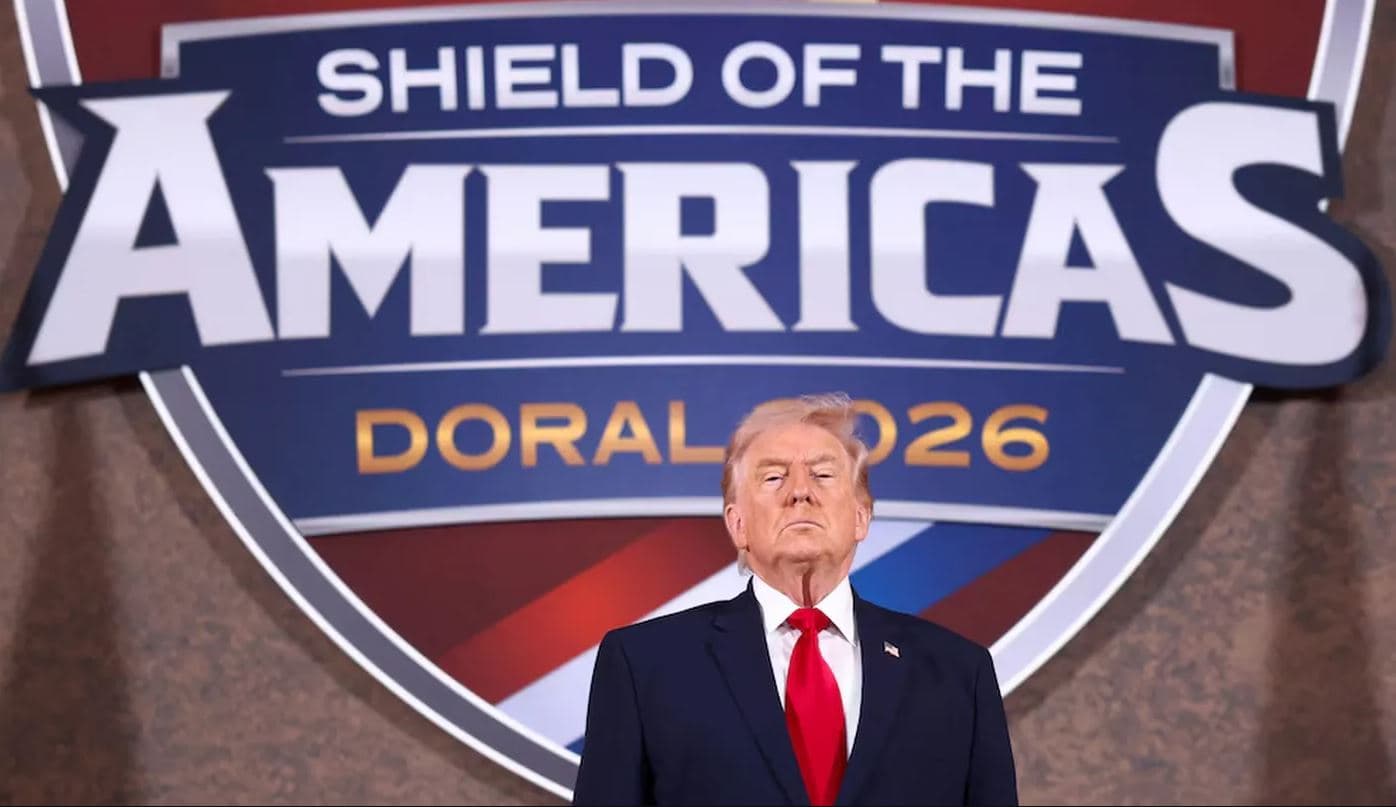 In a series of public statements made in early March 2026, President Donald Trump declared that Cuba's government is on the verge of collapse and that his administration is actively working to accelerate that outcome.
Despite reportedly being occupied, according to The New York Times, with military operations in Iran, President Donald Trump has not stopped making public pronouncements about Cuba.
On Thursday, March 5, in the Rose Garden of the White House — during a reception honoring Inter Miami players for winning the Major League Soccer (MLS) championship, and in the presence of club owner Jorge Más Santos, son of the late Jorge Más Canosa, founder of the anti-Cuban lobbying organization the Cuban American National Foundation — Trump set aside the sporting occasion to unleash his belligerent rhetoric against the island.
In one of his customary displays of arrogance, the president declared: "Cuba is going to fall soon, by the way, unrelated, but Cuba is also going to fall. They want to make a deal very badly. They want to make a deal, so I'm going to put Marco [Rubio] on it and we'll see how it goes. We're very focused on this right now. We have plenty of time, but Cuba is ready after 50 years."
"I just want to wait a couple of weeks. But I suspect that very soon we'll be celebrating again what's happening in Cuba," Trump added.
On that same day, the digital outlet Politico published an interview in which the president claimed his administration is playing a direct role in the downfall of Miguel Díaz-Canel's government. When asked about it, Trump replied: "What do you think? For 50 years, that has been the cherry on top."
"They need help. We are talking to Cuba," Trump emphasized, suggesting that the worsening conditions on the island are partly the result of pressure applied by Washington, including the disruption of Venezuelan oil supplies to Cuba.
"Well, it's thanks to my intervention that there is an intervention," the president said, referring to the ripple effects of the fall of Nicolás Maduro and the subsequent loss of Venezuelan oil, which had been crucial to Cuba's daily operations.
On Saturday, at the hemispheric "Shield of the Americas" summit — which brought together right-wing heads of state from across Latin America, ostensibly to forge a regional coalition against drug trafficking — Trump declared: "I will take care of Cuba," adding that the island's government is "at the end of the road, with no money, no oil, a bad philosophy, and has been bad for a very long time."
"And before, they were getting money from Venezuela, they were getting oil from Venezuela, but they don't have money from Venezuela anymore, they don't have oil, they have nothing. People can't even land in Cuba and they can't get gasoline to take off — they have to leave their planes there," he said.
"Cuba is a disaster. But I have heard so much about Cuba and Cuba is in its final moments, just as it stands now. It will have a great new life, but it's in its final moments of life as it currently stands," he continued, before suggesting: "A deal with Cuba — that will be an easy one."
According to Trump, the Cuban government "wants to negotiate, and it's negotiating with Marco [Rubio] and me. And I would think that a deal could be reached very easily with Cuba," adding that "for 50 years I have been hearing, since I was a child, about Cuba."
It is evident that the current president — whose apparent political education seems to extend no further than his past dealings with the New York organized crime figures who once controlled the construction unions — holds a profoundly distorted understanding of what Cuba actually is.
There is no other explanation for why he would speak of the island with such a level of arrogance and superficiality. Little can be expected from a leader who, as the statements above reveal, openly boasts with the utmost cynicism about subjecting an entire people to humanitarian crisis through "his intervention," only to then attempt to negotiate from a position of naked blackmail.
It is worth noting that the negotiations Trump envisions cannot be going particularly well, given that Cuban President Miguel Díaz-Canel has just characterized the Doral summit — at which Trump delivered his latest pronouncements on Cuba — as a "small reactionary and neocolonial Summit in Florida" and "an attack against the Proclamation of Latin America and the Caribbean as a Zone of Peace, an assault on the aspirations for regional integration, and a demonstration of the willingness to subordinate oneself to the interests of the powerful neighbor to the North, under the precepts of the Monroe Doctrine."
Moreover, who could seriously trust negotiations with a bully who has trampled upon the most elementary principles of diplomacy — one who, while claiming to engage in dialogue, abducts heads of state and, according to critics, orders the killing of civilians? Or place confidence in a perpetrator who, after committing what many have characterized as grave human rights violations, presents himself as the innocent defender of the victim?
The occupant of the White House, before dispatching his Secretary of State — who speaks Cuban Spanish but, by all appearances, does not fully think in English either — to deliver a blackmail proposal during a spare hour, would do well to first send him to complete a doctoral course on Cuban history. He might learn that fruit metaphors have not served U.S. ambitions well in this context. John Quincy Adams's coveted "ripe fruit" of 1823 took decades to materialize into the Spanish-Cuban-American War of 1898, only to slip entirely through Washington's fingers in January 1959.
As for Trump's "cherry on top" — history may well repeat itself. Sooner rather than later, it just might get lodged in his throat.
Translated by Sergio A. Paneque Díaz / CubaSí Translation Staff
