Trump’s labyrinth and Cuba’s resistance: An island that refuses to surrender to the empire
- Written by Redacción ¡ahora!
- Published in Opinion
- Hits: 1860
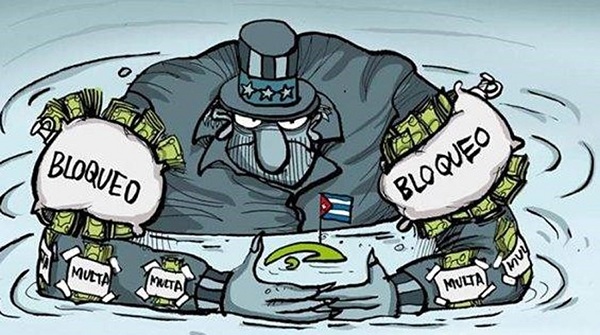
The United States’ foreign policy toward Cuba has once again displayed, in recent days, its classic contradiction: the rhetoric of absolute crushing clashes with the reality of a country that, no matter how much it is suffocated, refuses to submit. The arrival of the Russian oil tanker Anatoly Kolodkin at the port of Matanzas, with 730,000 barrels of crude oil, is not only a breath of fresh air for an island mired in an unprecedented energy crisis. It is, above all, a symptom of the labyrinth into which Donald Trump has fallen by trying to simultaneously play the role of the ruthless hawk and the pragmatic negotiator.
While the White House insists that “there is no change in policy,” reality belies the fiction. In January, the Trump administration imposed a de facto naval blockade, kidnapped the president of Venezuela—Cuba’s main historical fuel supplier—and threatened tariffs on any country that dared send oil to the island. The objective was clear: to collapse the Cuban economy, provoke an implosion of the political system, and force a transition tailored to Washington’s needs. But the result has been quite different: the blockade has failed to subdue Cuba, but it has exposed the very contradictions of the imperial regime.
Trump in his own labyrinth
In a matter of weeks, the US president went from declaring that “Cuba is finished” and that “it’s going to be next”—alluding to the kidnapping of Nicolás Maduro—to authorizing, with his explicit blessing, a sanctioned Russian vessel to break his own blockade. “If a country wants to send some oil to Cuba now, I have no problem with that, whether it’s Russia or not,” Trump said on March 29, in one of those statements that highlight the gap between maximum pressure rhetoric and actual decisions.
What explains this shift? The answer lies not in a sudden humanitarian interest—even though Trump invoked “the needs of the people”—but in the most basic geopolitical calculation. The policy of total strangulation was pushing Cuba to the brink of a humanitarian crisis of catastrophic proportions. And that crisis, instead of weakening the Cuban government, threatened to become a direct problem for the United States: an uncontrolled wave of migration, an ungovernable island ninety miles from Florida, and, above all, an ideal scenario for Russia and other adversarial actors to fill the vacuum left by Washington. Faced with this scenario, Trump opted for what he does best: a tactical retreat disguised as pragmatism.
The very legal framework of his administration betrays the improvisation. General License 134, issued by OFAC on March 12, temporarily authorizes the entry of Russian oil loaded before that date. It’s a legal pretext to prevent the ship from being intercepted, without needing to admit that the energy blockade policy has failed in its aim to subdue Cuba.
Cuba: unconditional resistance
While Trump navigates his own contradictions, Cuba maintains an unambiguous position: to resist without abandoning its principles. President Miguel Díaz-Canel Bermúdez has deployed a two-pronged strategy. Domestically, he has implemented the Economic and Social Program for 2026, which reorganizes the economy from the ground up to address fuel shortages and the tightening of the blockade. Internationally, he has offered dialogue and economic cooperation to the United States, but this offer rests on a non-negotiable premise: Cuban sovereignty, independence, and the political system are not up for discussion.
The Cuban Foreign Ministry has presented a roadmap for bilateral cooperation, but it has done so without the slightest hint of submission. The proposal is clear: if Washington is willing to recognize Cuba’s reality and respect its self-determination, there is room for cooperation. If what the US seeks is regime change, as Trump has hinted in his most aggressive statements, then the response will be the same as the island’s for more than six decades: resistance.
This stance is not mere rhetoric. Cuba knows, from bitter experience, that concessions under pressure do not guarantee stability, but rather open the door to new demands. The history of relations with the United States is full of broken promises and attempts to use economic strangulation to extract political concessions. That is why Havana’s position has been, and continues to be, one of not negotiating under threat.
The Island’s Paradox Facing the Empire
The contrast could not be more asymmetrical. The United States is the world’s greatest military and economic power, with almost unlimited resources to pressure a small, blockaded country facing enormous material difficulties. However, this apparent advantage becomes its own trap. The policy of maximum pressure has not succeeded in making Cuba abandon its principles, but it has put Washington in an uncomfortable position: either it allows the entry of Russian fuel (with the consequent propaganda victory for Moscow) or it faces a humanitarian crisis that would discredit it internationally and fuel the flow of migrants.
Cuba, on the other hand, has once again demonstrated its capacity to resist without renouncing its identity. This is not the first time the island has faced a critical situation. The so-called Special Period of the 1990s was much harsher in material terms than the current crisis, and yet the country persevered without yielding an iota of its sovereignty. Today, the Cuban government has allies such as Russia, Mexico, and other nations that have made it clear they will not accept a unilateral blockade imposed by Washington.
Mexico’s own president, Claudia Sheinbaum, has defended her country’s right to supply fuel to Cuba, pointing out that no external government can dictate with whom Mexico trades. And meanwhile, the arrival of the Russian tanker is a direct message to the White House: the island is not alone.
Beyond the Current Situation: A Recurring Pattern
What we are witnessing in recent weeks is not an isolated incident, but rather another chapter in a recurring pattern. The United States’ policy toward Cuba has historically oscillated between attempts at suppression and the temptation of controlled negotiations. From the rupture of relations in 1961, through the longest economic, commercial, and financial embargo in history, to the limited openings of the Obama era and the return to confrontation under Trump, all administrations have shared one objective: to change the Cuban political system.
What they have never achieved is for Cuba to relinquish its fundamental principles. Independence, sovereignty, and the right to build its own social project remain the anchor that sustains the island’s foreign and domestic policy. Neither the embargo, nor threats, nor media pressure have managed to bring Havana to its knees.
The Future: Collapse, Negotiation, or Stagnation?
In the short term, a scenario of prolonged stagnation is most likely to solidify. Trump will maintain his maximum-pressure rhetoric to appease the hardliners in his electoral base, but he will continue to allow tactical exceptions to prevent an uncontrollable crisis. Cuba, for its part, will receive intermittent aid from its allies, enough to survive but not enough to thrive. The empire will continue to believe that time is on its side; the island will continue to demonstrate that resistance is a matter of principle, not deadlines.
The offer of dialogue presented by Cuba is an opportunity that Washington could seize if it were willing to abandon its obsession with regime change. But history teaches us that, for the United States, recognizing the legitimacy of the Cuban system remains a seemingly impossible step. Meanwhile, Cuba is forging ahead with its own economic program, opening itself to foreign investment without relinquishing state control, and pursuing a diplomacy that is forging numerous alliances to break the blockade.
A Lesson in Dignity
In a world where major powers often impose their will through the brute force of sanctions or military threats, Cuba’s resistance takes on a significance that transcends its borders. It is not merely the survival of a small island nation; it is a demonstration that dignity and political consistency can prevail over the arsenal of an empire.
Trump finds himself in a labyrinth he himself has helped to create: he wants Cuba to collapse, but fears the consequences of his own blockade; he wishes to project firmness, but is forced to yield to reality. Cuba, on the other hand, has a clear path: to resist, to negotiate without surrendering, and to defend its principles to the bitter end. While the White House wavers between bravado and pragmatism, the island remains what it has always been: an example that sovereignty is neither surrendered nor sold, no matter how suffocating the blockade.
This is no ordinary battle. It is proof that, for Cuba, independence is not a bargaining chip, but the very foundation of its existence. And as long as that remains true, no matter how many labyrinths the empire constructs, the island will continue to find its way. / Taken from RHC
