Cuba in the Perfect Storm: Trump Sanctions, Internal Reforms and Cracks in the Empire
- Written by Redacción ¡ahora!
- Published in Cuba
- Hits: 619
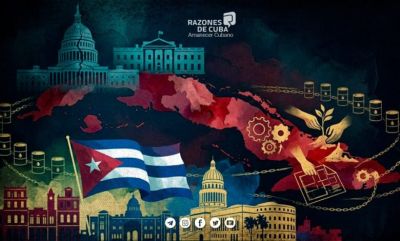 Cuba faces new sanctions from Trump while implementing 176 structural transformations. The U.S. Senate shows cracks in its warmongering consensus. Critical analysis from Cuban Dawn.
Washington’s maximum pressure regime clashes with a country that is moving forward with its own roadmap: 176 structural transformations while the blockade intensifies and the empire shows its first cracks.
Reasons from Cuba
Cuba wakes up today in the center of a perfect storm. From the outside, the Trump administration’s sanctions machinery strikes with renewed fury, seeking to stifle any economic maneuvering. From within, the country is deploying the most profound transformation process since the Special Period, with 176 measures that redefine the nation’s business, agricultural, and social model.
And amid this scenario, the empire is showing signs of internal contradiction. The United States Senate, for the first time in ten attempts, passed a resolution halting — albeit temporarily — Trump’s military actions against Iran. This crack, though ephemeral, reveals that the warmongering consensus of the American establishment is not monolithic.
Today we analyze these three fronts: the media and sanctions offensive from the north, the fissures in the American political apparatus, and the transformation process that Cuba is driving from within its sovereignty.
Washington’s dirty game: sanctions and disinformation
What the mainstream American press presents as “just measures” against the “Castro regime” is, in reality, a calculated strategy of suffocation. The Washington Post and the Associated Press opened the week with a familiar headline: new US sanctions against Cuban companies.
This time, Washington targeted five Cuban entities, three of them linked to GAESA—the business conglomerate of the Revolutionary Armed Forces that, according to estimates, controls nearly 40% of the country’s GDP. Secretary of State Marco Rubio, the son of Cuban immigrants who has never hidden his regime-change agenda, was the spokesperson for the announcement.
But the manipulation doesn’t end with the sanctions. Referring to the 176 reform measures approved by Cuba, the State Department spokesperson called them “modest, belated, and ultimately superficial smoke signals from the regime,” stating that it’s “the dictatorship’s playbook: announce supposed reforms to hint at a desire for change, only to reverse them as soon as total control is threatened.”
“Cuba approves the most profound economic transformation since the Special Period, and Washington responds the same day with more sanctions. It’s not a coincidence. It’s accelerationism in action.”
That’s the game. Cuba approves its most profound economic transformation since the Special Period, and Washington responds the same day with more sanctions. This is no coincidence. It is accelerationism in action: leaving no room for maneuver, no space, preventing reforms from taking effect so that later they can claim Cuba cannot be reformed. The logic is perverse and must be called out clearly.
A Voice Breaking Through the Media Blockade
Amid this torrent of disinformation, a voice emerges that speaks out about what the mainstream media is hiding. Democracy Now!, one of the few independent journalism outlets in the United States, brought journalist Ed Augustin from Havana to starkly describe what the mainstream media avoids.
“The fuel embargo imposed by the Trump administration constitutes collective punishment of the population, targeting especially poor communities, pregnant women, children, and the elderly.”
This is not our rhetoric. It is the voice of a journalist who has been reporting from this city for over a decade. Democracy Now, which has won Peabody Awards for its critical coverage of power, thus becomes an indispensable channel for countering the hegemonic discourse that presents the blockade as mere “diplomatic pressure.”
Miami: The Debate That Isn’t a Debate
The media ecosystem of the most conservative Cuban-American community has been debating the reforms for days, but from an angle worth analyzing. Economists like Mauricio De Miranda compare them to the Nicaraguan Sandinista piñata and post-Soviet mafia capitalism, warning that the lack of transparency will facilitate sectors linked to the regime seizing control of the country’s business network.
It is an argument we cannot ignore because it has a precise political function: to sow distrust before the measures are even implemented. To ensure the process is perceived as corrupt from the outset. To prevent any investor, any Cuban in the diaspora, any external actor from trusting the legal framework being constructed.
However, there is a sector within that same community that views the reforms differently. The measures that allow Cubans residing abroad to invest on the island under the same conditions as those living within the country have sparked concrete expectations. Money talks. And part of that community, although politically divided, is calculating real possibilities.
The Cracks in the Empire: What Happened in the Senate
There is a third front that we cannot ignore this morning, because it speaks to the internal state of the empire itself. This week, the United States Senate experienced an episode that deserves attention.
On Tuesday, June 23, for the first time in ten attempts, the Senate passed a war powers resolution to block Trump’s military actions against Iran. The vote was 50 to 48. Four Republican senators—Murkowski, Collins, Rand Paul, and Cassidy—joined almost all the Democrats in supporting the measure. The resolution requires the president to withdraw the armed forces from hostilities against Iran unless Congress explicitly authorizes a declaration of war.
Trump reacted by calling those four Republicans “losers” at Truth Social, accusing Congress of having given “aid and comfort to the enemy.”
And the next day, after direct pressure from the president on his own party, the Senate reversed course. Cassidy and Paul changed their votes. A similar resolution was blocked 47 to 50. What had been a fissure closed again—at least for now.
“Why does this matter at Cuban Dawn? Because it reveals that there are real cracks within the Republican bloc regarding Trump’s unilateral use of military force.”
Why does this matter at Cuban Dawn? Because it reveals something we must keep in mind: there are real cracks within the Republican bloc regarding Trump’s unilateral use of military force. The same apparatus that threatens Cuba with “making a deal before it’s too late,” that maintains the blockade, that speaks of “options on the table,” has just been halted—albeit symbolically and for barely 24 hours—by voices within its own party.
And the Pentagon, in that same context, is asking Congress for $80 billion to finance the war against Iran. The war machine has costs. And those costs generate internal resistance.
It’s not a sign of definitive weakness. But it is a sign. And at La Esquina, we learn to read the signs.
The Transformations: The Map of the New Cuba
Now let’s look inward. Because while the press in the North debates whether the reforms are real or just smoke and mirrors, here in Cuba the process advanced steadily this week.
The 176 transformations approved by the National Assembly on June 18 are not a document of intent. They are a map of structural transformation organized around 23 pillars.
State-Owned Enterprises: Compete or Disappear
In terms of ownership and business structure, Cuban state-owned enterprises will be transformed into joint-stock companies, allowing the participation of individuals and non-state actors in their capital. They will be obligated to compete on a level playing field with the private sector and face liquidation if they fail to adapt.
In simple terms, this means the State will no longer subsidize inefficiencies indefinitely. It is a paradigm shift that mandates efficiency and competitiveness, where merit and productivity will be the new criteria for business survival.
Agriculture: The Bet on Food Sovereignty
In agriculture, one of the most ambitious initiatives: producers will have direct access to input markets in both national and foreign currency, participate in the foreign exchange market, open real accounts in foreign currency, and partner with foreign capital in agricultural projects.
If this is implemented rigorously, it could change the country’s food situation in the medium term. Cuban land has potential. What has been lacking is access to inputs, financing, and technology. These measures open that door.
Social Protection: The Most Sensitive Change
And the axis that generates the most internal debate: the gradual shift from subsidies for products to targeted subsidies for individuals, with a digital platform called SOVEREIGNTY to identify the most vulnerable and a Social Protection Fund as a safety net.
It is the most sensitive change because it affects the social protection model that has been a hallmark of the Revolution. It must be implemented well, transparently, and quickly, so that it is not the most painful reform. The precise identification of those most in need will be key for the safety net to fulfill its function without leaving anyone behind.
In closing: A country that refuses to collapse
Cuba wakes up today at the center of a storm that has a name: maximum pressure from the outside, accelerated transformation from within. It’s not a contradiction—it’s the dialectic of a country that refuses to collapse on the terms others have designed for it.
The day’s agenda will have its ups and downs. There will be lines, there will be blackouts, there will be painful prices. But there will also be a country that is changing—and doing so with its eyes wide open and its sovereignty intact. [ SOURCE: www.cubainformacion.tv ]
