
| ELECTIONS IN CUBA |
| A Democratic Process |
|
|
|
Nominations of Candidates for People's Power Elections Starting on February 24th
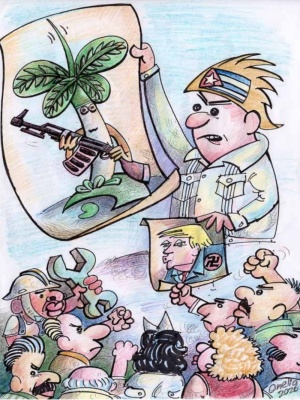
“Under the dictatorship of the Castro brothers, there is no democracy or freedom or elections in Cuba,” they’ve said again and again, as if wanting to make the lie come true ?a formula invented by Hitler’s Minister of Propaganda, Joseph Goebbles.
In his work Nuestro Camino: Análisis del proceso de rectificación (Our Way: Reviewing the Rectification Process), essayist Dario Machado wrote some years ago: “... It is ironic that Cubans are required to embrace so-called democratic formulas, such as the multiparty system, which have failed in their attempts to create a fair society.”
The capitalist world defends its idea of democracy, but its mechanisms are really aimed at limiting the people’s participation in government issues, while making them believe that they really have the freedom to choose their representatives.
The Cuban system does guarantee the real participation. Though our model is different, its primary objective is making everybody feel that they are an important part of society, and that they have the same opportunities.
What follows is description of our electoral system as seen by a Spanish journalist:
1. All citizens over 16 have the right to vote. Registration is automatic and free.
2. Candidates are directly nominated by voters at public assemblies --in contrast with capitalist countries where only parties can nominate.
3. There are is no campaigning.
4. Elections are transparent. Ballot boxes are guarded by children and adolescents, and votes are counted publicly.
5. Candidates can only be elected if they cast over 50% of the valid votes. If they don’t reach such percent in the first round, those who got the most votes will go to a second round.
6. The vote is free, equal and secret. All Cuban citizens have the right to elect and be elected. Since there is only one party, you vote directly for the candidate you want.
7. All representative bodies of state power are elected and renewable.
8. Those elected must are accountable to the people.
9. Those elected can be recalled at any time during their mandate.
10. Deputies to the National Assembly (Parliament) are elected for a term of 5 years.
12. The membership of the Parliament is representative of the most diverse sectors of the Cuban society.
13. One deputy is elected for every 20,000 inhabitants, or fraction greater than 10,000. All municipalities are represented at the National Assembly, and the core base of the system, the constituency, actively participates in its composition. Each municipality elects at least two deputies, according to its number of inhabitants. 50% of the deputies must be delegates from the constituencies, who must be residents in the territory.
14. The National Assembly elects from its deputies, the State Council and the Chairman. The President of the Council of State, is Head of State and Head of Government. This means that the head of the Cuban government has to undergo two elections: first be elected as a deputy by the people, via a direct and secret vote; and then by the other Members, also via a free, direct and secret vote.
15. As the National Assembly is the Supreme Organ of state power and legislative, executive and judicial functions are subordinated to it, the Head of State and Government can not dissolve it.
16. Law approval is subject to a majority vote of the Deputies. A law is not submitted to consideration until it has undergone a wide consultation process that includes most strata of society.
The main feature of the Cuban political system is that it guarantees the systematic participation of the people in the decision making process, which is fundamental in a democracy.
/Translated by Ahora
| < Prev | Next > |
|---|
Periódico AHORA | Subir


Sections